
What is eKYC: Global Trends, Indian Innovations, and the Future of Digital Trust


Electronic Know Your Customer (eKYC) is the digital process of verifying identity for regulatory and security purposes. Instead of paper documents and branch visits, eKYC uses digital records, biometrics, or online databases to confirm identity in seconds. From opening bank accounts to activating SIM cards, eKYC has transformed onboarding worldwide—accelerated further by the pandemic’s demand for remote services.
This article explores what eKYC is, why it matters, its advantages, India’s innovations, how it ties to foundational ID systems globally, and the future of digital trust.
What is E-KYC?
eKYC is simply KYC done digitally. While the objective remains the same—ensuring customers are who they claim to be—eKYC achieves this online and paperlessly. For example, instead of photocopying IDs, users upload a digital credential or provide a biometric scan, which institutions verify against secure databases in real time.
The Financial Action Task Force (FATF) clarifies that when digital ID systems are reliable and independent, non-face-to-face onboarding may be considered standard or even low risk under a risk-based approach. This global endorsement has accelerated adoption across industries.
Importance of E-KYC: Regulatory, Economic, and Inclusion
Regulatory compliance and security
Banks and fintechs must perform due diligence to prevent fraud and money laundering. eKYC strengthens compliance by using biometrics, cryptography, and automated checks—reducing forgery risk. Privacy frameworks like GDPR and India’s Digital Personal Data Protection (DPDP) Act, 2023 require consent, purpose limitation, and strong data safeguards. Aadhaar eKYC, for example, embeds user consent and data protection in its design.
Economic efficiency
Traditional KYC was slow and costly. Digital verification reduces this from days to minutes. According to India’s Economic Survey 2023-24, Aadhaar-based eKYC cut verification costs from about ₹1,000 (~$12) to around ₹6 (~$0.06). This drop enabled banks and fintechs to onboard millions more customers, fueling India’s digital financial services boom.
Financial inclusion and convenience
eKYC eliminates geographic and bureaucratic barriers. Ethiopia’s central bank has announced its Fayda digital ID will serve as the primary bank ID, with phased linkage through 2026. A farmer can open a micro-loan account via mobile, or a migrant worker can activate telecom services without traveling. eKYC thus drives digital inclusion, extending into welfare, healthcare, and telecom.
Advantages of E-KYC Over Traditional KYC
Aspect | Traditional KYC | Electronic KYC |
Speed | Paper forms, manual checks, days/weeks | Real-time verification in minutes |
Cost | Staff, storage, courier costs (~$12 in India) | Paperless, automated (~$0.06 per customer) |
Fraud Risk | Forged/tampered documents, manual errors | Secure biometrics, OTP, and cryptographic checks |
User Experience | In-person visits, cumbersome paperwork | Remote, mobile-first, frictionless |
Compliance | Repeated paper updates, fragmented audits | Centralized updates, digital logs, audit-ready |
In short, eKYC is faster, cheaper, more secure, and user-friendly—when implemented with robust technology and data protection.
Types of E-KYC in India
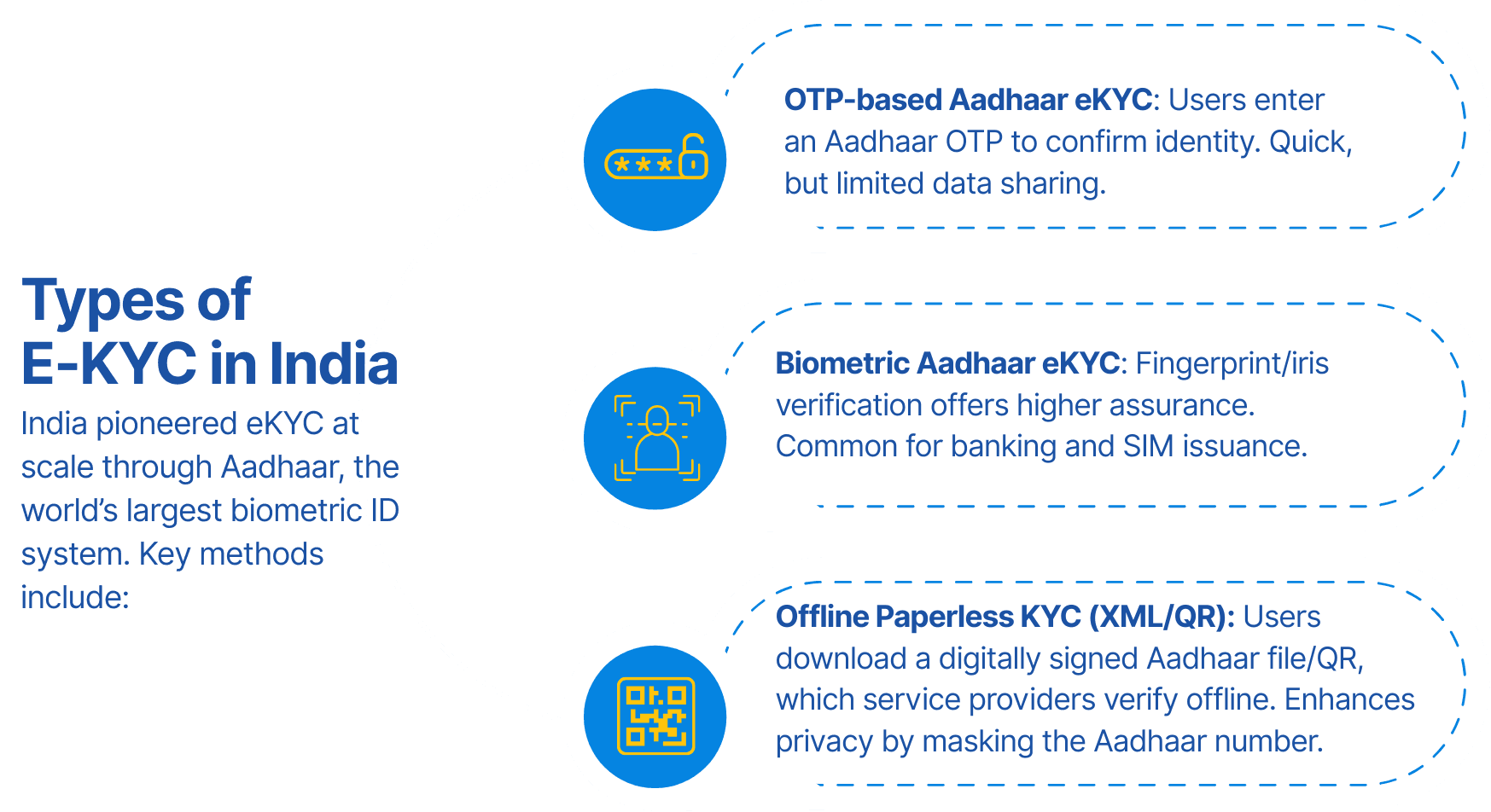
Other methods include Video KYC, where banks verify customers over a live call. All are governed by the Aadhaar Act and the RBI’s KYC Master Direction, requiring explicit user consent and licensing of entities.
How E-KYC Connects to Foundational ID Systems
eKYC thrives when built on foundational identity systems—universal, government-backed IDs that serve as the “root of trust.”
India’s Aadhaar: UIDAI reports sustained high authentication volumes, with hundreds of millions to billions monthly across biometrics and OTP. Aadhaar has become the backbone of India’s eKYC ecosystem.
MOSIP in Africa & Asia: The open-source Modular Open-Source Identity Platform (MOSIP) is being adopted in 25+ countries. Zambia, for instance, is deploying MOSIP with World Bank support to create a national eKYC platform.
Europe’s eIDAS & EUDI Wallet: The updated framework entered into force in May 2024; each EU Member State must provide at least one Digital Identity Wallet by 2026. These wallets let citizens store and selectively share verified credentials across borders, creating a privacy-first foundation for eKYC.
Across contexts, the model is the same: foundational IDs anchor digital trust, and eKYC leverages them for instant, compliant verification.
The Future of Digital Trust
Advanced technologies: AI-driven fraud detection, stronger liveness checks, and new biometrics (behavioral, voice) will enhance security. Decentralized/self-sovereign identity and digital wallets will expand user control.
Global standards: W3C’s Verifiable Credentials and ISO privacy standards, aligned with FATF guidance, are shaping interoperable digital ID assurance. Reusable KYC models may emerge across borders.
User trust and privacy: Expect fine-grained consent dashboards and privacy-preserving tools (like zero-knowledge proofs). The principle: “frictionless, but not reckless.”
Expanding applications: Beyond finance and telecom, eKYC is spreading to healthcare, travel, education, and even voting. Foundational IDs + eKYC will serve as the infrastructure of digital trust.
Conclusion
eKYC has evolved from a compliance requirement to a cornerstone of digital transformation. India’s Aadhaar-driven model proved the impact on cost, scale, and inclusion; MOSIP and EU frameworks show how others are adapting with open and privacy-centric approaches.
The global trajectory is clear: foundational IDs + eKYC = trusted, inclusive digital economies. With standards maturing and technology advancing, identity verification will become instant, secure, and privacy-respecting—empowering billions to participate confidently in the digital world.
Let's build trusted infrastructure, together.
Tell us what you're working on. Our team will get back within one business day.