
Understanding Foundational IDs: The Key to Legal Identity for All
What are Foundational IDs?
Foundational IDs are identification systems that establish legal identity for individuals from birth, typically beginning with civil registration (e.g., a birth certificate) and often extending to a nationally recognized number or card. They differ from functional IDs (like driver’s licenses or voter cards) because they are created as a universal proof of identity across many uses, not for a single program. A foundational ID serves as a universal proof of identity, underpinning an individual’s existence in the eyes of the law. It enables access to rights, services, and opportunities.
A well-designed foundational ID system creates a register of unique, verified identities that public and private institutions can rely on to answer the questions “Who are you?” and “Do you officially exist?”.
Importance of Foundational IDs
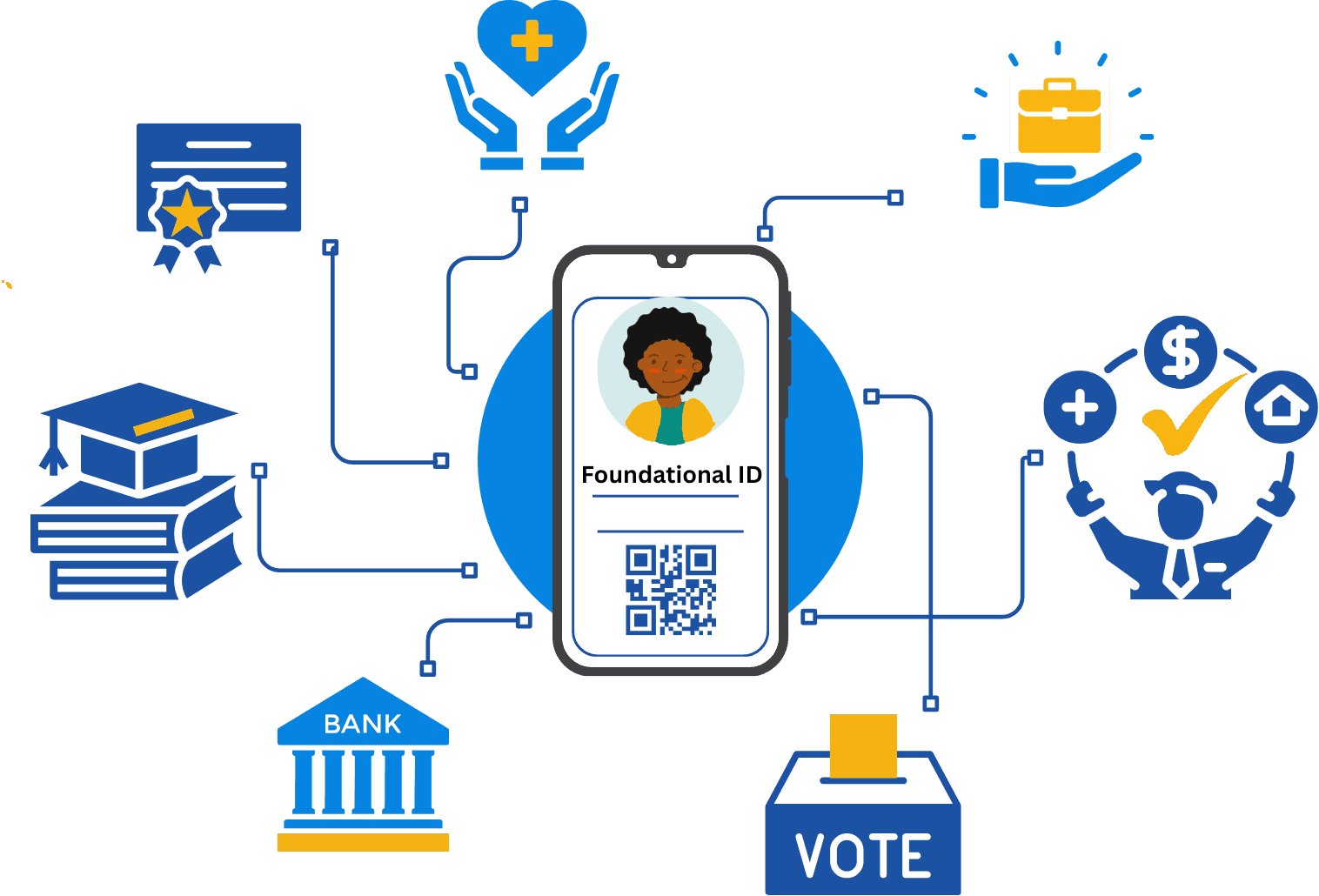
Without official ID, people struggle to access jobs, schooling, healthcare, social protection, and financial services; identification is therefore a key enabler for participation in modern life and for claiming legal rights. Foundational IDs are essential for full participation in modern life. Without official identification, individuals may be unable to:
Prove age or name to get a job.
Enroll in school or obtain certificates.
Access welfare benefits.
Open a bank account.
Receive healthcare.
Exercise the right to vote.
Lacking ID can trap people in cycles of systematic poverty, marginalisation, and exclusion. Digital ID programs—when inclusive and trusted—also help governments reduce fraud and leakage in benefits, improve service delivery, and increase administrative efficiency; they similarly help the private sector by making reliable verification easier (e.g., for KYC). In short, foundational IDs are both a gateway to dignity and opportunity for individuals and a tool for efficiency and transparency in governance.
Identity for All: UN SDG 16.9
Legal identity is recognized globally as a foundational right, with the UN’s SDG Target 16.9 calling on countries to “provide legal identity for all, including birth registration, by 2030.” The UN Legal Identity Agenda and SDG resources emphasize that birth registration and legal identity underpin inclusive development and the commitment to “leave no one behind.”
Globally, about 850 million people are estimated to lack official identification, disproportionately among the poorest and in lower-income countries—underscoring the scale of the challenge and the development gains from inclusive ID.
This gap perpetuates marginalization: those without ID cannot easily access healthcare, education, or employment. Achieving “identity for all” is therefore both a moral imperative and a development necessity. When every person can say “I am officially recognized,” it affirms dignity, strengthens planning and governance, and ensures that no one is left behind.
Challenges in Implementing Foundational IDs
Rolling out a national ID system is complex. Common challenges include:
1. Coverage and Exclusion
Remote, low-income, displaced, and marginalized groups may face higher barriers to enrollment—especially where legacy civil registration is weak.’
How to overcome this: Proactive design choices (e.g., fee waivers, mobile enrollment, simple processes, etc.) can mitigate exclusion risks.
2. Infrastructure and Accessibility
Limited electricity, internet, or transport infrastructure hampers biometric enrollment in remote regions. Low literacy and digital literacy can also affect enrollment.
How to overcome this: Offline data capture, portable kits, battery-powered devices, and user-friendly processes.
3. Privacy and Security Concerns
Foundational IDs collect sensitive demographic and biometric data, making them targets for misuse or cyberattacks. Without strong safeguards, trust erodes.
How to overcome this:privacy-by-design, data minimization, strong legal frameworks, cybersecurity controls, and independent oversight are critical to earn trust.
4. Administrative and Political Challenges
Nationwide ID systems require strong political will, funding, and inter-agency coordination. Without this, fragmented programs may emerge.
How to overcome this: Whole-of-government approaches, clear communication, and sustainable financing.
5. Technology and Vendor Lock-In
Costly, proprietary systems risk unsustainability and dependency on a single vendor.
How to overcome this: Open standards, interoperable systems, open-source solutions, and local capacity building.
Despite these challenges, countries are finding ways to succeed through pilot projects, international partnerships, and context-specific technology choices.
What Makes a “Good” Foundational ID System?
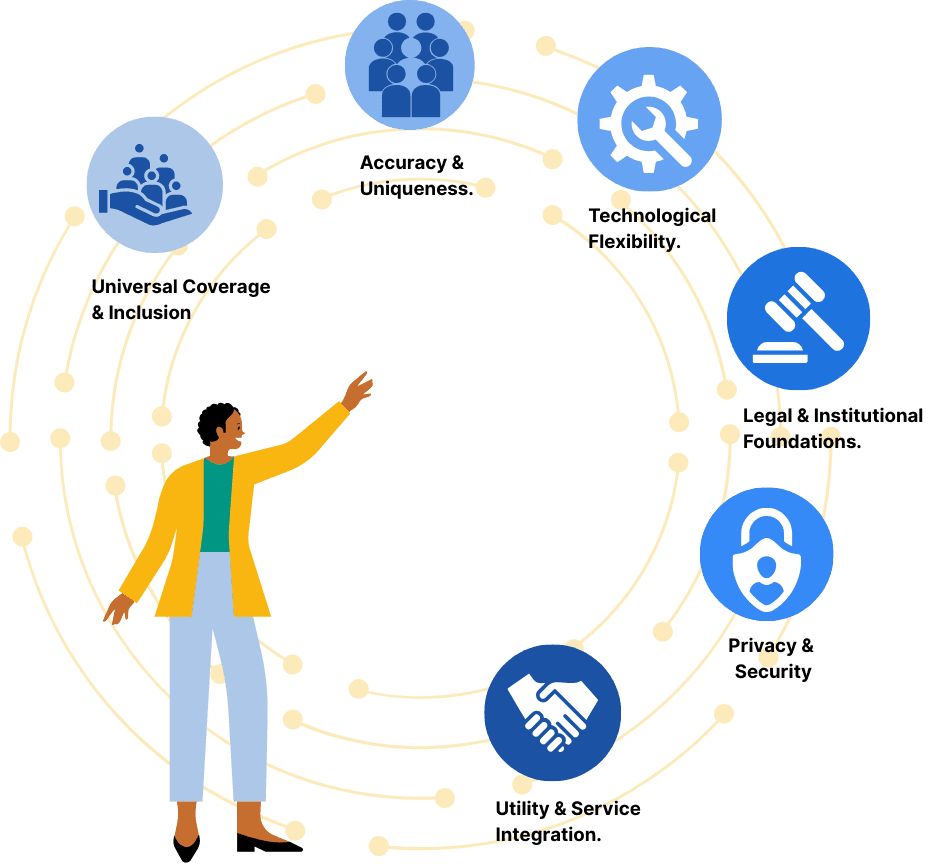
Successful ID systems share common features:
Universal Coverage & Inclusion. Easy, affordable enrollment and continuous updates across life events to reach all residents.
Accuracy & Uniqueness. Robust identity proofing and, where used, biometric de-duplication to establish a single, authoritative identity record.
Privacy & Security. Strong data protection law, clear access rules, encryption, and auditable governance; consent-based sharing and minimal necessary data.
Legal & Institutional Foundations. Clear legislation, defined mandates, and capable institutions with the resources to maintain the system.
Technological Flexibility. Modular, interoperable architecture (APIs, multiple authentication factors), adaptable to context (smartcards, mobile IDs, biometrics, QR).
Utility & Service Integration. Easy-to-use authentication services for agencies and businesses (e.g., verification APIs) that connect ID to priority use cases in welfare, finance, health, education, and e-government.
At its best, a foundational ID is inclusive, secure, user-centric, and trusted, balancing national needs with individual rights.
Ooru’s Expertise in MOSIP and Foundational ID Solutions
Building a national ID requires more than technology—it needs expertise, open standards, and sustainable local capacity. Ooru Digital specializes in implementing MOSIP (Modular Open-Source Identity Platform), a leading open-source foundation for national identity systems, and partners with governments to build inclusive, citizen-centric ID ecosystems.
São Tomé and Príncipe (STP): Implementing a DPI Layer
In STP, Ooru is supporting the government in creating a Digital Public Infrastructure (DPI) layer, with MOSIP-based national digital IDs as a core building block. Our role while implementing the national IDs includes:
Local Configuration: Tailoring MOSIP to national requirements.
Capacity Building: Training engineers and officials for long-term ownership.
Scalable Rollout: Guiding the shift from pilot to full national adoption.
Our Approach Across Projects
Open Standards: Modular, interoperable solutions that prevent vendor lock-in.
Knowledge Transfer: Building local capacity through training and support.
Community Contribution: Enhancing MOSIP components such as the Inji credential module.
Privacy and Security: Embedding global best practices in data protection from the start.
Foundational IDs unlock benefits across multiple domains:
Social Protection: In India, Aadhaar-enabled Direct Benefit Transfers (DBT) saved billions by reducing fraud in welfare schemes.
Financial Inclusion: In Pakistan, NADRA’s biometric ID allowed millions to open bank accounts and receive remittances securely.
Healthcare & Education: Peru’s RENIEC uses the national ID to ensure birth registration and link children to healthcare and schooling.
E-Government: Estonia’s e-ID enables digital signatures, tax filing, and even online voting—widely cited as a global benchmark.
Elections: Ghana’s biometric voter ID reduced fraud in elections and strengthened trust in results.
Private Sector Innovation: In the Philippines, the PhilSys ID is being integrated into fintech onboarding to expand access to unbanked populations.
In short, foundational IDs are the trust layer for modern economies, supporting innovation and inclusion alike.
Conclusion
Foundational IDs are far more than administrative tools. They are:
A human right (recognized in SDG 16.9)
A foundation for inclusion and dignity
A driver of efficiency, transparency, and economic growth
For individuals, they unlock opportunities. For governments, they enable better planning and service delivery. For societies, they create trust and fairness.
Ooru Digital is proud to contribute to this global mission by delivering open-source, secure, and scalable identity solutions. Through projects across countries and sectors, we are working to ensure that no one is left behind—making “Identity for All” a reality.