Digitising a Nation's Public Service Delivery

Year:
2025, 2026
Service:
Digital Public Infrastuctures
Industry:
In Progress
#
DigitalPublicInfrastructure
#
NationalID


São Tomé and Príncipe partnered with Ooru Digital to build interconnected Digital Public Infrastructures spanning identity, authentication, citizen services, and payments — moving public services off paper onto a unified, trusted digital layer anchored in MOSIP-based national identity and a verifiable credential ecosystem.
Introduction
São Tomé and Príncipe is a two-island nation in the Gulf of Guinea with a population of 222,000. Its economy has long been shaped by agriculture, fishing, and cocoa, and its public administration has historically relied on paper-based processes and in-person service delivery.
The Government of São Tomé and Príncipe has prioritised digital transformation as a national objective, with the goal of providing efficient, accessible, and trusted public services to all citizens. The foundations for this shift already exist: internet penetration stands at 61%, mobile phone penetration at 71%, and 14% of the population is between the ages of 18 and 24, a demographic well-positioned to adopt digital services.
Two national institutions lead the programme. The Directorate General of Registries and Notary (DGRN), under the Ministry of Justice, is responsible for civil registration, identity records, and the national registry system, SIGA. The National Institute for Innovation and Knowledge (INIC) administers the gov.st domain, operates the government's digital platforms, and leads national initiatives on e-government, data governance, and cybersecurity.
Together, DGRN and INIC are establishing the institutional and technical foundation for a nationwide Digital Public Infrastructure.
Challenge
Before the programme, the delivery of public services in São Tomé and Príncipe faced three interrelated challenges.
Manual and paper-based administration - Most government services depended on physical forms, in-person verification, and manual record handling. This resulted in slow processing times, a significant administrative burden on officials, and a higher risk of errors in citizen records.
Fragmented government systems - Public institutions operated largely independently, with limited interoperability between departments. Citizens were frequently required to visit multiple offices and submit the same documents repeatedly to access a single service. The absence of a shared identity layer or data exchange mechanism made cross-ministry coordination difficult.
Limited access and inclusion - Rural communities encountered barriers in reaching service points, due both to travel distance and to inconsistent connectivity. Manual identity verification processes were time-consuming and, in practice, exclusionary — disproportionately affecting the citizens most reliant on public services.
Addressing these challenges required more than incremental improvements. It called for a foundational digital infrastructure capable of supporting service delivery at population scale.
Solution
In partnership with DGRN and INIC, we are implementing a Digital Public Infrastructure built on open standards and reusable digital building blocks. The architecture comprises four interoperable layers, supported by a national Data Exchange Layer.
Identity. A MOSIP-based national digital identity system, anchored in DGRN's SIGA registry. Biometric enrolment and deduplication processes ensure that each citizen is uniquely represented, preventing duplicate or fraudulent records and establishing the registry as the authoritative source of citizen identity.
Authentication. e-Authentication services and digital signatures enable citizens to securely identify themselves online and allow ministries to issue and accept signed documents through digital channels, removing the dependency on paper-based verification.
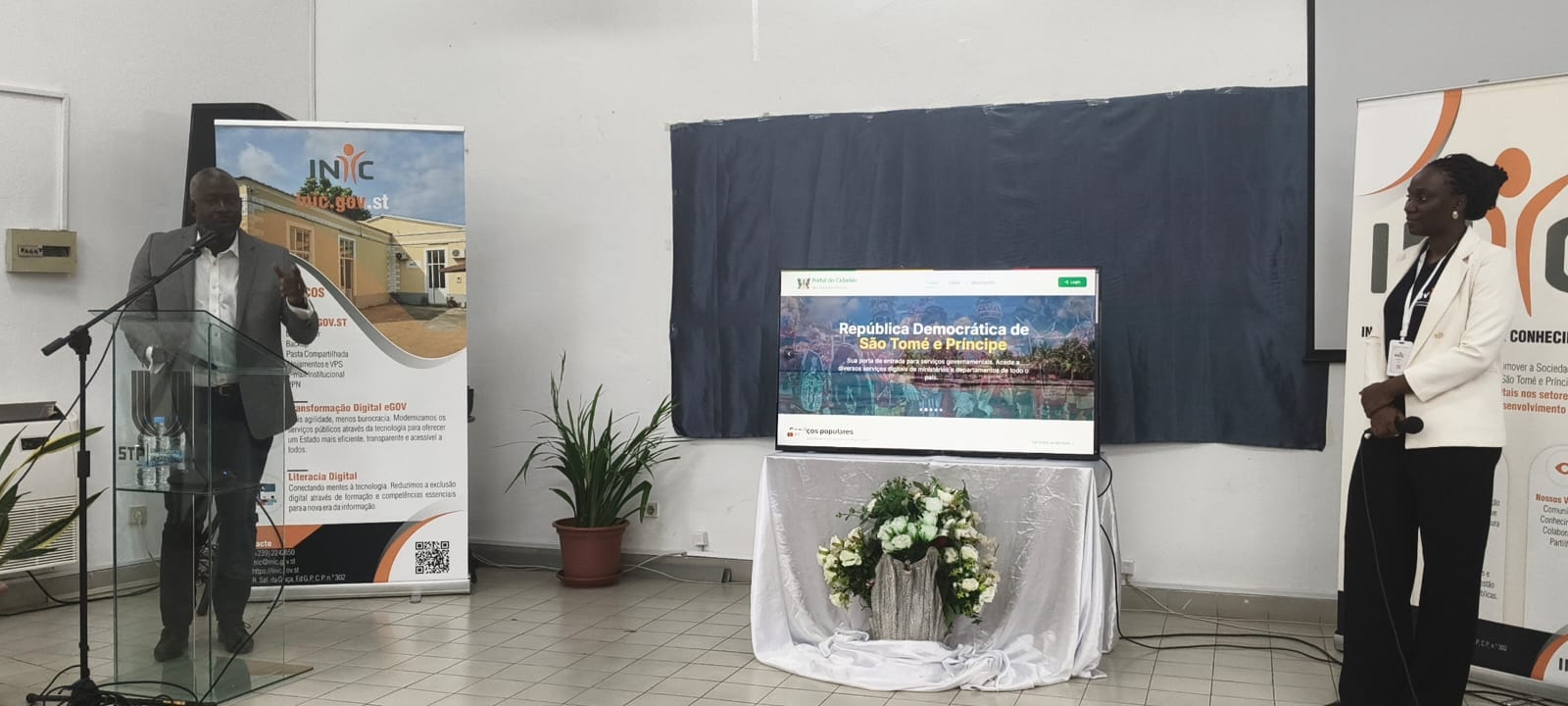
Citizen Services. A national Citizen Portal and mobile application provide a single digital entry point to more than 150 government services across ministries, including civil registration, taxation, health, employment, education, housing, social protection, and pensions. The platform is operated by INIC on the national gov.st domain and supports integrated payments and service applications.
Verifiable Credentials. A verifiable credential ecosystem enables government-issued documents — qualifications, licences, entitlements — to be portable, reusable, and verifiable both online and offline. Credentials issued by one ministry can be presented to another without requiring re-submission of source documents.
The programme follows a phased rollout. Phase 1 (2025–2026) delivers the MOSIP-based national identity system and the Citizen Portal. Phase 2 (2026) introduces the Data Exchange Layer, the verifiable credential ecosystem, and the mobile application. Phase 3 (2026) expands the infrastructure to include digital signatures, eLocker, and e-Authentication, and extends coverage into health, education, tax, social protection, and social security.
Expected Outcomes
The programme is in active implementation, with full rollout targeted for 2026. On completion, the Digital Public Infrastructure is expected to deliver outcomes across three dimensions.
Improved service delivery. Citizens will be able to access government services through a single digital channel, reducing travel, waiting times, and paperwork. Secure digital identity verification will enable faster processing, more transparent procedures, and consistent service access across ministries.
Greater inclusion and trust. Both urban and rural communities will gain easier access to essential services without repeated office visits. Digital and offline-capable identity verification will allow citizens to prove their identity reliably regardless of location, supporting inclusion and strengthening public trust in government systems.
Foundations for the digital economy. A unified digital infrastructure will support online transactions, digital credentials, and broader participation in the digital economy. Strong cybersecurity, data governance, and reliable identity systems are expected to encourage business activity, create digital employment opportunities for young people, and increase confidence in digital government.
Beyond these immediate outcomes, the programme establishes a durable national platform. With identity, authentication, services, credentials, and data exchange in place, future government services can be digitised progressively — without rebuilding the underlying infrastructure each time. The foundation is national, the standards are open, and each new service that comes online will benefit from the work that came before.
